Washington DC, like hundreds of other cities in the U.S., has a dirty water problem. The problem goes by the name of combined sewer overflow (CSO). CSO is a fancy way of saying when it rains a lot, our shit and piss go straight into the river untreated.

This foul condition is caused by sewer systems that combine sewage flows (from toilets and drains) with stormwater flows (from lots and streets). Seven hundred and seventy-two cities in the U.S. have these antiquated systems that overflow when it rains a lot. Cities that were built after 1900-1910 solved the problem by building separate systems for sewage and stormwater.

Washington DC is under a court order to fix the problem. The original court-ordered plan is a multidecade, multibillion-dollar program of installing giant water storage tunnels. It would reduce raw sewage discharges by 98 percent and would be paid for by doubling water bills over a 20-year period.

In August 2011, the DC Water and Sewer Authority proposed a test of low-impact development (LID) in order to reduce its costs and construction requirements. LID is a set of stormwater management practices that directs runoff to places where it can soak into the ground: swales, rain gardens, trenches, porous pavement, etc. If we put stormwater into the ground instead of sewer pipes, says DC Water, the pipes will overflow less often.

But local environmental groups are wondering just how feasible the DC Water proposal is. They are objecting to it — in particular, the proposed eight-year delay in tunnel construction and potential reductions in tunnel capacity. While proven cleanup techniques are delayed, DC Water will experiment with LID techniques that may or may not provide significant reductions of stormwater runoff. Washington Post columnist Mike DeBonis describes the situation:

Problem is, the environmental advocates on the other side of the tunnel agreement remain skeptical of the low impact development plan. They are understandably hesitant to give up the guaranteed prevention of sewage outflows for a speculative reduction in runoff that would require years of delay.

Leaders of 16 environmental groups signed a letter late last month saying, essentially, that low impact development is a good idea and all, but they’re not convinced it’s a proven way to handle a serious sewage problem. Just today, Earthjustice — the legal group behind the lawsuit that forced the tunnel deal — told the Environmental Protection Agency it will “strongly oppose” any attempt to change the agreement to swap tunnel capacity for green infrastructure.

“Can green development cut your D.C. Water bill?” Washington Post, May 24, 2012

EPA Stormwater Regulations to Clean Up the Chesapeake Bay

In addition to the court-ordered consent decree to clean up its CSO problem, DC must contend with EPA regulations written to clean up the Chesapeake Bay. These regulations took effect in 2011 and address water quality impacts from polluted stormwater runoff. When stormwater flows over buildings and lots, and across streets and parking lots, it picks up pollutants that eventually end up in the Chesapeake Bay.

Although this is a separate issue from CSO cleanup, the EPA regulations also specify that DC should use LID to reduce water pollution. Can LID do double duty for both programs — can the same installations fix the CSO problem and clean the Chesapeake Bay? Is there any coordination between the two programs?

Proof of LID

More generally, is there any evidence LID works at large scales? I know that LID has been tested and proven at the level of individual sites. And I know that EPA regulations and other regulations are based on models that assume those results will scale up to the city, county, and watershed scale.

That’s not what I am asking about. I’d like to find empirical evidence that LID improves water quality at scales larger than the site. The ward, district, city, county, regional or watershed scale, for example.

We know that centralized storage and treatment methods work, because the results are evident. In Paris, the Seine River has been heavily polluted for many decades, partly because of its CSO system. Now the cleanup effort has progressed to the point that 28 fish species have returned, including migratory Atlantic salmon. In Copenhagen, the harbor used to be an industrial waste dump. Now it is clean enough for people to swim in. Both of those cities have densely developed waterfronts that are extremely popular. Cleanup has been accomplished by installing centralized water treatment plants and stormwater tunnels and reservoirs.

What similar successes has LID demonstrated?

Maybe LID has not yet been implemented at large enough scales to produce measurable effects on any major water bodies. But LID is being mandated in more and more jurisdictions, with the expectation that it will be effective at large scales. This seems backward. The effectiveness of LID at large scales should be empirically demonstrated before it is accepted as an alternative to conventional, proven methods of controlling water pollution at large scales.

What happens if cities and counties mandate LID across their entire jurisdiction, and subsequently the overall water quality of the watershed shows little improvement? How long should they wait for results? Is there a backup plan?

Additional quotes and links below the fold.

(more…)

A Wall Street Journal article, The Hidden Toll of Traffic Jams, covered several studies that linked vehicle exhaust with a variety of health impacts. The WSJ spun this as a congestion problem, even though it mentioned only one study that investigated congestion (at a toll plaza on Interstate 95). The WSJ also called the redesign of Times Square a congestion reduction measure, but in reality the congestion impacts have been mixed and travel times have increased on some routes. The Times Square redesign primarily benefits livability and pedestrian safety and comfort.

Maybe this goes without saying, but I think new urbanism has to be careful about the kind of congestion relief it advocates. There are some street network improvements that help increase the walkability and livability of an area. There are other types of construction that mostly help cars speed faster and increase sprawl.

The former can include a fine-grain mesh of small blocks, eliminating curb cuts for driveways, and intelligent systems like predictive navigation. The latter can include roadway widening, flyovers, and new freeways. There are also some measures that can go either way, like tunnels, intersection improvements, and traffic signal coordination. Depending on the design and context, these can contribute to livability or make a thoroughfare more pedestrian-hostile.

Hybrid vehicles like the Prius turn the congestion equation upside down: at lower speeds they rely more on electric propulsion, which reduces gas consumption, emissions, and health impacts. Plug-in hybrids and battery electric cars do even better. From the point of view of street-level vehicle pollution, these cars are the best thing since unleaded gasoline.

Entry limits for entire urban districts are the most direct way to reduce congestion, but outside of historic European city centers there doesn’t seem to be much appetite for doing this. Congestion tolls/fees for urban districts can be effective, but they are regressive, and the political process gets hung up on the costs and discounts the benefits. Other transportation demand measures can help, and the framework and metrics used to identify congestion are critical. Todd Litman writes:

… increased development density tends to increase congestion measured as roadway level-of-service or delay per vehicle trip, since more trips tend to be generated per acre. From this perspective, Smart Growth tends to be harmful and sprawl tends to be helpful for reducing congestion problems. However, higher density tends to increase land use Accessibility and Transportation Options, resulting in shorter trip distances and shifts to alternative modes such as walking and public transit. Although streets in higher density urban areas may experience more level-of-service E or F, implying serious congestion problems, urban residents spend less time delayed by congestion because they have closer destinations and better travel options. As a result, per capita (as opposed to per-vehicle trip or per-driver) congestion delay tends to be greater in lower-density, automobile-dependent suburban areas such as Los Angeles and Houston than in higher-density urban areas such as New York and San Francisco, because low-density areas have more per-capita vehicle mileage.

Congestion Reduction Strategies, Victoria Transport Policy Institute

New urbanists have to be informed and nuanced when navigating the congestion debate, because it easily can be turned to favor sprawl.

Below the fold: links about the level-of-service measure and its reform.

(more…)

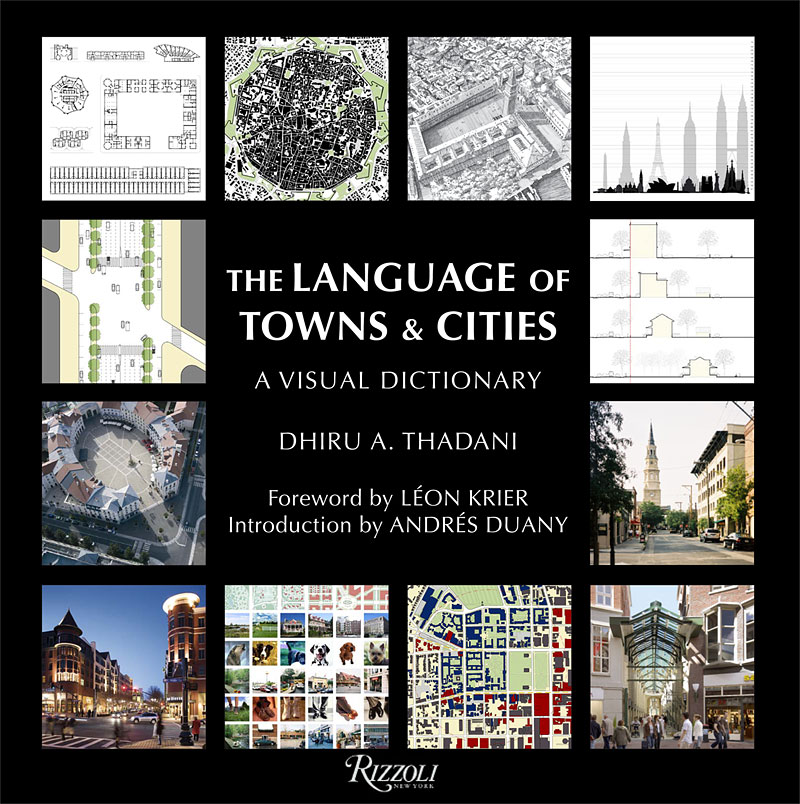
I’m very pleased to say The Language of Towns & Cities: A Visual Dictionary has been published and is available for purchase. The massive tome was written by Dhiru Thadani with more than fifty contributors. I was the editor of the book as well as a contributor.

My leading observation is that the title is a misnomer. It’s not a visual dictionary, it’s a visual encyclopedia — a combination of reference book and coffee table book. It represents about 15 years of creative production by Dhiru, including his maps of urban spaces around the world and his insights from 30 years as an architect and town planner. Numbers also tell the tale: the book consists of 804 pages; more than 500 subject matter entries ranging from single paragraphs to full essays; and more than 2,500 diagrams, illustrations, and photographs.

The book is physically heavy and bulky. Its dimensions are 10.4″ x 10.4″ x 2.75″ and it weighs 9 pounds… not what you would call a portable book. Once it gets parked on a desk or coffee table, it’s not going to move far.

The Language of Towns & Cities is a fine example of the craft of bookmaking. Credit is due to Rizzoli Publications and the Chinese firm that manufactured the book. It is beautifully printed, with heavy coated paper stock that showcases the vibrant, lush photography. The binding is sturdy and lies flat at any page, which many books these days are not made to do.

The authorial tone of the book is accessible and straightforward, aiming for clarity rather than obfuscation by jargon. Indeed, The Language of Towns & Cities is a work of anti-jargon, because it introduces concepts, defines terms, explores patterns, and reveals history.

Being an encyclopedia, The Language of Towns & Cities is arranged alphabetically. Rob Krier’s review on Amazon.com describes his childhood joy at browsing reference works. Krier says that reading Language made him feel the same way. Each flip of the page brought a different subject into view, encouraging serendipitous exploration and discovery.

To sum up, Language combines beautiful images, a wide variety of subject matter, accessible writing, and fine bookmaking. I call it the ultimate browsing book on urban design.

What follows is the dust jacket book description, list of contributors, and a sample from the book including the complete table of contents.

(more…)

The draft LEED 2012 rating systems were released for public comment today. The proposals contain new and revised credits that relate to the location, transportation options, and urban design of projects. Here I’ll review the changes that are of greatest interest to new urbanism and smart growth advocates.

The following proposals are in the Building Design & Construction document, which includes most of the LEED rating systems. “LT” stands for Location and Transportation, which is a new category within LEED systems.

Please note that “LEED 2012″ is my own personal shorthand for these draft proposals. The more accurate and official term is “proposed update to LEED” with no year associated.

LT Prerequisite: Bicycle Storage

LEED has been critiqued for a variety of flaws both real and alleged. But one thing you can always count on is a mention of the bike rack credit. Every critic or reporter has a sworn duty to point out that bike racks can earn a LEED credit point. Installing bike racks is cheap and easy compared to (for instance) making buildings more energy efficient, and may be worth the same number of credit points. This has consistently been presented as an example of LEED illogic.

Worry no longer! Installing bike racks is now a prerequisite for all LEED projects, except for those in totally unbikeable locations. The racks have to be safe and convenient — no stashing behind garbage dumpsters. Residential projects provide additional bike storage for their residents.

This prerequisite is both functional and symbolic, providing a visible signal that transportation mode choice is an essential aspect of LEED. Also, creating a bicycle storage prerequisite allows the bar to be raised for performance in the “Bicycle Network, Storage and Changing Rooms” credit.

(more…)

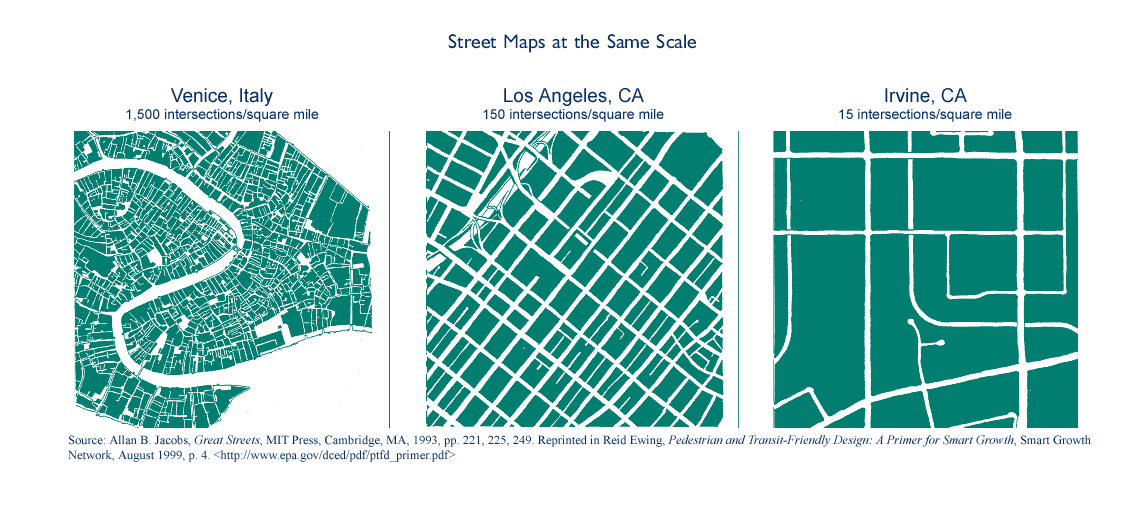
Intersection density is the number of intersections in an area. It corresponds closely to block size — the greater the intersection density, the smaller the blocks. Small blocks make a neighborhood walkable. This diagram shows three street layouts — extremely walkable, moderately walkable, and unwalkable — with their counts of intersections per square mile:

Intersection density makes surprising news in a study by the formidable academic duo of Reid Ewing and Robert Cervero. They have published Travel and the Built Environment: A Meta-Analysis in the Summer 2010 issue of the Journal of the American Planning Association.

As the title notes, the study is a meta-analysis: a study of 50 other studies about travel and the built environment. The authors look at the results from each of the 50 studies, and then pool all of those results into ten built environment measurements, including intersection density.

Their findings? Of all the built environment measurements, intersection density has the largest effect on walking — more than population density, distance to a store, distance to a transit stop, or jobs within one mile. Intersection density also has large effects on transit use and the amount of driving. The authors comment,

This is surprising, given the emphasis in the qualitative literature on density and diversity, and the relatively limited attention paid to design.

In other words, intersection density is the most important factor for walking and one of the most important factors for increasing transit use and reducing miles driven, but gets relatively little attention in research and in public policy.

(more…)

Download a print version of this essay.

Consider two views about sustainable cities. Call one the Green City, and the other the Compact City.

Green City: A sustainable city is a green city. It has lots of plants and trees that make the city more beautiful, provide habitat for wildlife, and help clean the air and water. It even has community gardens where people grow food and flowers.

Compact City: A sustainable city is a compact city. It has lots of buildings and activities conveniently close together so people can walk, bike, and take transit. It even has paved squares and plazas where people gather and participate in markets, performances, free speech, and recreation.

The Green City is popular as never before. Everyone wants more trees, more landscaping, more living green in their neighborhoods. Stormwater standards are shaping up to be the major vector by which the Green City is delivered — even mandated, in many cases. What does this mean for the Compact City? Is there a conflict between the two views?

In fact, both views are necessary. We have the technical know-how to create neighborhoods that are both compact and green. But sometimes standards and regulations don’t recognize this, particularly stormwater standards. Well-intentioned stormwater standards and regulations can put compact urban development at a disadvantage. They may have the unintended consequence of promoting sprawl, which hurts watersheds more than compact development.

Unlike many barriers to compact development, this is not a technical, social, financial, or even political problem. It is largely an administrative problem. Doing the right thing is simply more difficult for administrators.

This essay suggests four guidelines for stormwater management that support and encourage compact neighborhood development. These guidelines can help put regulations back on the right track, and may also help to make the job of administering stormwater more manageable:

  1. Recognize density as a best management practice
  2. Allow off-site mitigation, preferably in the neighborhood
  3. Plan according to the Transect (neighborhood context)
  4. Design according to the Transect (neighborhood context)

(more…)

In a September 2009 paper The Market for Smart Growth, market researchers at Robert Charles Lesser & Co. reported strong market demand for housing in new urban communities. In a number of U.S. cities, their consumer surveys found at least one-third of the market prefers new urbanism, transit-oriented development, and urban and suburban infill communities:

Proprietary consumer research conducted by Robert Charles Lesser & Co. LLC (RCLCo) in various U.S. real estate markets has consistently found that about a third of respondents, given the option, would seriously consider New Urbanist communities and housing products in selecting a new home. The majority of the RCLCo studies were conducted for builders and developers as input to planning new smart growth developments. … An examination of the survey evidence relative to consumer housing preferences in the context of demographic projections demonstrates that the size of the market for dense walkable communities is increasing. (emphasis added)

(more…)

This summer, members of the Congress for the New Urbanism will vote on LEED for Neighborhood Development. LEED-ND is a system for rating the sustainability of neighborhoods. The vote is a membership referendum on whether CNU endorses the release of LEED-ND in its present state. To encourage informed participation in the vote, the DC chapter of CNU has released An Introduction to LEED-ND for CNU Members.

The six-page article covers the essential points that CNU members should know as they consider their ballot. Topics include the background of LEED, how the system is administered, credits of special interest to new urbanism, what the system does and does not do, and the purpose and meaning of the vote. The article is written by Laurence Aurbach, CNU DC Chapter secretary and member of the LEED Location and Planning Technical Advisory Group.

Cross-posted from CNU DC

(more…)

Download a print version of this essay.

Part One of this essay covers the background, characteristics and drawbacks of functional classification, and evaluates some of the leading alternatives. Part Two continues by proposing a replacement, a sustainable transportation network classification, covering the block-scale and neighborhood-scale relationships. Part Three concludes by covering the city-scale relationship and the congestion-related impacts of a sustainable network.

City Scale

The ideal pattern of regional growth has been debated at least since the 19th century. In the 1960s and 70s the focus of the debate sharpened on efficiency and sustainability, and the “Compact City” was suggested to be the ideal. The Compact City redirects all growth into a single urban core, maximizing density while minimizing the consumption of farms, forests and agricultural land. It explicitly counteracted the dominant trend of decentralized suburban sprawl.

Some of the benefits of the Compact City idea have been confirmed by researchers. Cities with higher density and more compact form have much less per capita driving (Newman and Kenworthy, 1999). In existing cities, the trend of sprawling suburban growth causes an explosion in the amount of auto driving; a policy of refocusing growth, mixed use and transit in the urban core will halt that explosion and slightly reduce the amount of driving (Simmonds and Coombe, 2000).


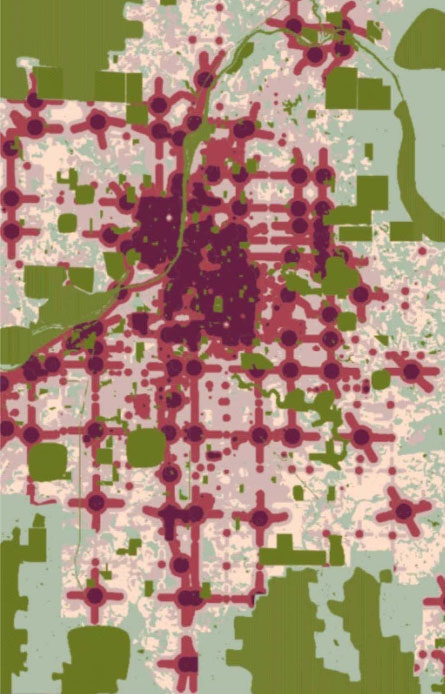
Analysis of city-scale development patterns shows that focusing growth on high-capacity transit nodes will have the greatest CO2 reduction effect. Image credit: Eliot Allen, “Cool Spots”

(more…)

Download a print version of this essay.

Part One of this essay covers the background, characteristics and drawbacks of functional classification, and evaluates some of the leading alternatives. Part Two continues by proposing a replacement, a sustainable transportation network classification, covering the block-scale and neighborhood-scale relationships. Part Three concludes by covering the city-scale relationship and the congestion-related impacts of a sustainable network.

A sustainable network classification ideally will do several things.

  • Actively encourage sustainability (as defined previously in the sustainable transport section); do not support unsustainable network patterns and operations.
  • Be concise, easy to remember and easy to explain.
  • Address a range of scales, a range that is at least as wide as that covered by functional classification.
  • Incorporate advanced knowledge about network function and best practices in network planning.

To reach these goals, a sustainable network classification is proposed. The classification has three primary relationships, each applying to a different scale. The three scales are block scale, neighborhood scale, and city scale. This allows each relationship to focus on the factors most relevant to its scale, without unnecessarily confusing factors from different scales or combining them inappropriately.

(more…)

Download a print version of this essay.

Every field has its foundational working concepts and the field of traffic engineering is no exception. It has a concept called functional classification, which is the core, guiding idea underlying the roadway system of the United States and many other nations. Functional classification is the conceptual foundation of the auto-dependent built environments where most Americans live.

The primary vision of functional classification is moving more and more cars at faster and faster speeds. This has certain benefits, but also a wide range of disastrous consequences for the built environment and the people who live in it. Hundreds, possibly thousands of reform-minded transportation planners and engineers have determined that the roadway functional classification system should be replaced.

It should be replaced by guiding concepts that support a more efficient, safer, less-polluting transportation system – concepts that support a wider range of choices for neighborhood living and daily travel. What factors should be considered when formulating a sustainable transportation system? What proposals have already been made?

Part One of this essay explores those questions. Part Two continues by proposing a replacement, a sustainable transportation network classification, covering the block-scale and neighborhood-scale relationships. Part Three concludes by covering the city-scale relationship and the congestion-related impacts of a sustainable network.

(more…)

The Brad Pitt-narrated PBS series e² ( “the Economies of being Environmentally conscious”) has several episodes about urban design and planning. For a general introduction to walkable, transit-oriented design and planning, I recommend the episode “Portland: A Sense of Place.” It focuses on the city’s rail transit and aerial tram, the Pearl District redevelopment, and the quality of life that can result from downtown revitalization with good urban design.

Even better is the episode “Seoul: The Stream of Consciousness” which focuses on Seoul’s Cheonggyecheon Restoration Project. This was a major freeway in the heart of the city that was torn down and replaced with a linear park and recreated running stream. The best thing about this episode is the sense of hope and renewal for the city that is conveyed by the residents’ pride in their new park.

These episodes are beautifully produced, not wonky at all, and will certainly hold anybody’s attention. The episodes can be viewed at www.e2-series.com. Click on “Webcasts” and scroll down to the episode titles. They are also available on DVD and from iTunes.

(more…)

The report Life-cycle Environmental Inventory of Passenger Transportation in the United States bills itself as “the first comprehensive environmental life-cycle assessment of automobiles, buses, trains, and aircraft in the United States.” The report, by Mikhail V. Chester of the Institute of Transportation Studies at Berkeley, goes far beyond counting the fuel consumed by vehicles. It considers the energy and materials used to build stations, terminals, roadways, runways, tracks, bridges, tunnels and parking, as well as maintenance, heating, lighting and more. A full life-cycle accounting of travel modes has been a long time coming; it is critically needed and tremendously welcome.

The findings on life-cycle energy use are summarized in this chart:

Read on for a summary of the findings, and a discussion of how the results are affected by urban design context.

(more…)

There are a variety of actions that property developers may take to help solve global warming. One is the purchase of carbon offsets — financial credits representing renewable energy or other facilities that reduce greenhouse gas emissions. Developers may purchase carbon offsets to offset the vehicle emissions associated with their land development projects. This is undoubtedly better than no action at all; however, offsets suffer from a number of functional and philosophical shortcomings that render them less-than-optimal as a solution. There are more direct and effective actions available, and those are what the sustainable development industry should encourage.

There have already been flaws uncovered in the carbon offset industry, ranging from obvious cheating and scams, to sincere firms using flawed calculation methods. For the purpose of this discussion, let’s ignore all of that. Let’s assume that all carbon offsets adhere to a high standard like the Gold Standard.

Even so, there is something less than ethical about paying somebody else to solve the problem you aren’t solving yourself. Especially when they happen to be halfway around the world. Whatever happened to “Think Globally, Act Locally”? That saying is drawn from a distinguished philosophical tradition (Leopold Kohr, E.F. Schumacher, Rene Dubos, etc.) and it is still relevant today.

Carbon offsets perpetuate the fiction that we can pay others to solve global warming while doing nothing to change our own patterns of energy use. All energy experts recognize that it will be extremely difficult to replace the current level of energy production with clean, carbon-free sources. Many claim it is impossible. The task of converting to carbon-free energy will be far easier if it is accompanied by a reduction in the demand for energy. Especially here in the U.S., we cannot simply expect technology to fix all of our carbon emissions. We are so profligate in our usage that some degree of demand reduction will be required. Our challenge is to reduce energy demand while maintaining a high quality of life.

(more…)

At the CNU Transportation Summit 2008, two presentations were especially consequential for the study of street networks. Both reported preliminary findings about the public safety implications of street connectivity. The results deserve attention from planners and transportation engineers.

Norman Garrick and Wesley Marshall, of the University of Connecticut’s Center for Transportation and Urban Planning, investigated the relationships between connectivity, network configuration, density, severe vehicle crashes, and mode choice. Matt Magnasco of the Charlotte (N.C.) Department of Transportation, studied the effect of connectivity on fire station service area and capital facilities planning.

In the extended entry, summary descriptions of both presentations.

(more…)

Page 1 of 512345